Find the finished product first
An assignment prompt often mixes several kinds of information: what to make, what to include, how to make it, and when it is due. Before planning your work, ask one question: What am I supposed to hand in or present? The answer might be an essay, a slideshow, a lab report, a drawing with a written explanation, or a short talk. Write that finished product at the top of your page. It gives the rest of your task list a destination.
Next, circle or copy the action words in the prompt. Words such as compare, explain, calculate, support, revise, and present tell you what you must do with the material. Notice the difference between “describe two solutions” and “compare two solutions.” A description might explain each one separately; a comparison also needs to show how they are alike or different. If a word is unfamiliar, look it up or ask your teacher what it means in this assignment.
Separate requirements from choices
Read the prompt again and collect anything that would affect whether your work is complete. Look for a required topic, number of examples, format, length, materials, submission method, and due date. If there is a rubric, check it too: it may name parts of the work that are easy to overlook. Put these details in a short requirements note rather than relying on memory.
Then mark what you get to choose. A prompt might require a presentation about a community issue but let you select the issue and the way you organize your slides. Keeping requirements and choices separate prevents two common problems: spending time deciding something the teacher has already decided, and treating an important requirement as optional. If instructions seem to conflict, make a note to ask about them before you get far into the project.
Turn the prompt into small actions
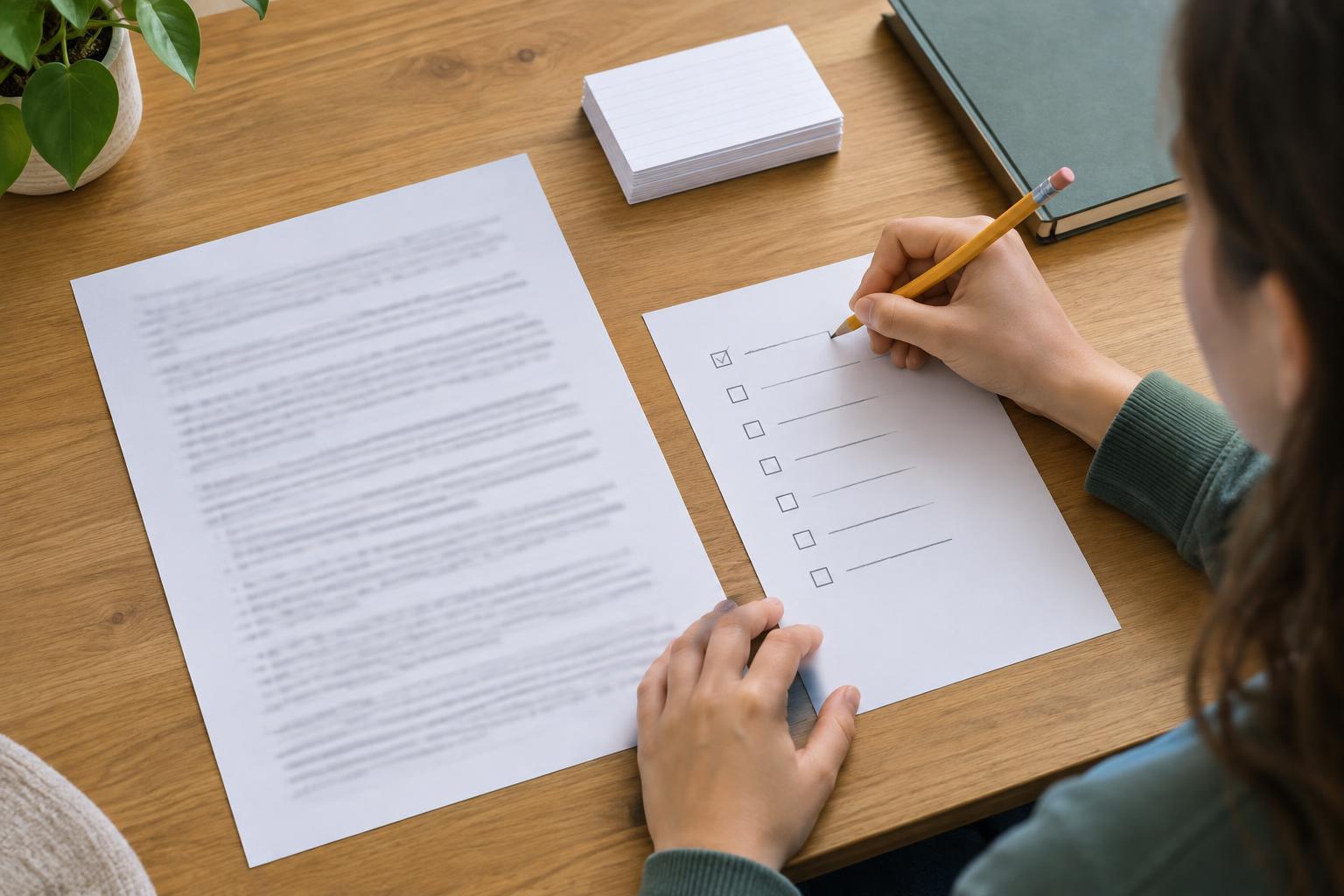
Suppose a prompt says: “Choose a character from a novel, explain how the character changes, and support your ideas with three moments from the story in a two-page response.” The final product is a two-page response. The requirements include explaining change and using three story moments. A useful task list could read: choose a character; find three moments that show change; write one sentence about what changes; plan the order of the response; draft it; check that each moment supports the explanation; revise for clarity; check the length and submit.
Each item should describe an action you can begin, not a vague goal such as “work on English.” If a step still feels too big, split it again. “Find three moments” could become “skim the beginning for one moment,” “find a moment near the middle,” and “look at the ending.” Some assignments do not need many steps, and that is fine. The purpose is to make the next move visible, not to create the longest possible list.
Put the steps in a workable order
Some tasks depend on others. You usually need to understand the question before choosing evidence, and you need a draft before you can revise it. Arrange your list so those dependencies make sense. If the assignment involves a partner, materials you must borrow, or feedback from a teacher, place those steps early enough that you are not waiting on someone else at the last minute.
Check the due date and estimate where the work might fit in your available study time. You do not have to predict every minute accurately. A simple plan such as “choose and gather examples today, draft next study period, review before submitting” is more useful than hoping you will remember the whole assignment later. For a larger project, add a personal checkpoint for a first draft so the final day is not the first time you see all the pieces together.
Use the list as a check, not just a plan
As you work, cross off completed actions and adjust the list if you discover a missing step. Before submitting, return to the original prompt. Compare your finished work with the action words, requirements, and rubric rather than checking only whether you completed your own list. That final comparison can catch a missing example, an unanswered part of the question, or a format detail you forgot.
If you cannot tell what the prompt is asking, write down the specific point of confusion. “Do the three examples need to come from different chapters?” is easier for a teacher to answer than “I don’t get it.” Turning a prompt into tasks will not remove every challenge, but it can replace the feeling of “I have to do all of this” with a clear first step and a way to see your progress.