Start with a quick check, not a full rewrite
Class notes are a record of what you noticed and wrote down, not a complete guide to everything you need to know. Reviewing them helps you separate ideas you can explain from ideas that only look familiar. You do not need to copy every page neatly to get started. Set aside a short, focused period after class or before your next study session, and choose one lesson or topic to review.
First, scan the page for headings, key terms, examples and questions. Mark anything that seems unfinished, such as a missing definition or a step you could not write down fast enough. Add a brief note about what is missing rather than guessing. If you have a class handout or assignment directions, compare them with your notes to see whether you covered the main ideas. This first pass gives you a manageable list of things to check.
Close your notes and explain the idea
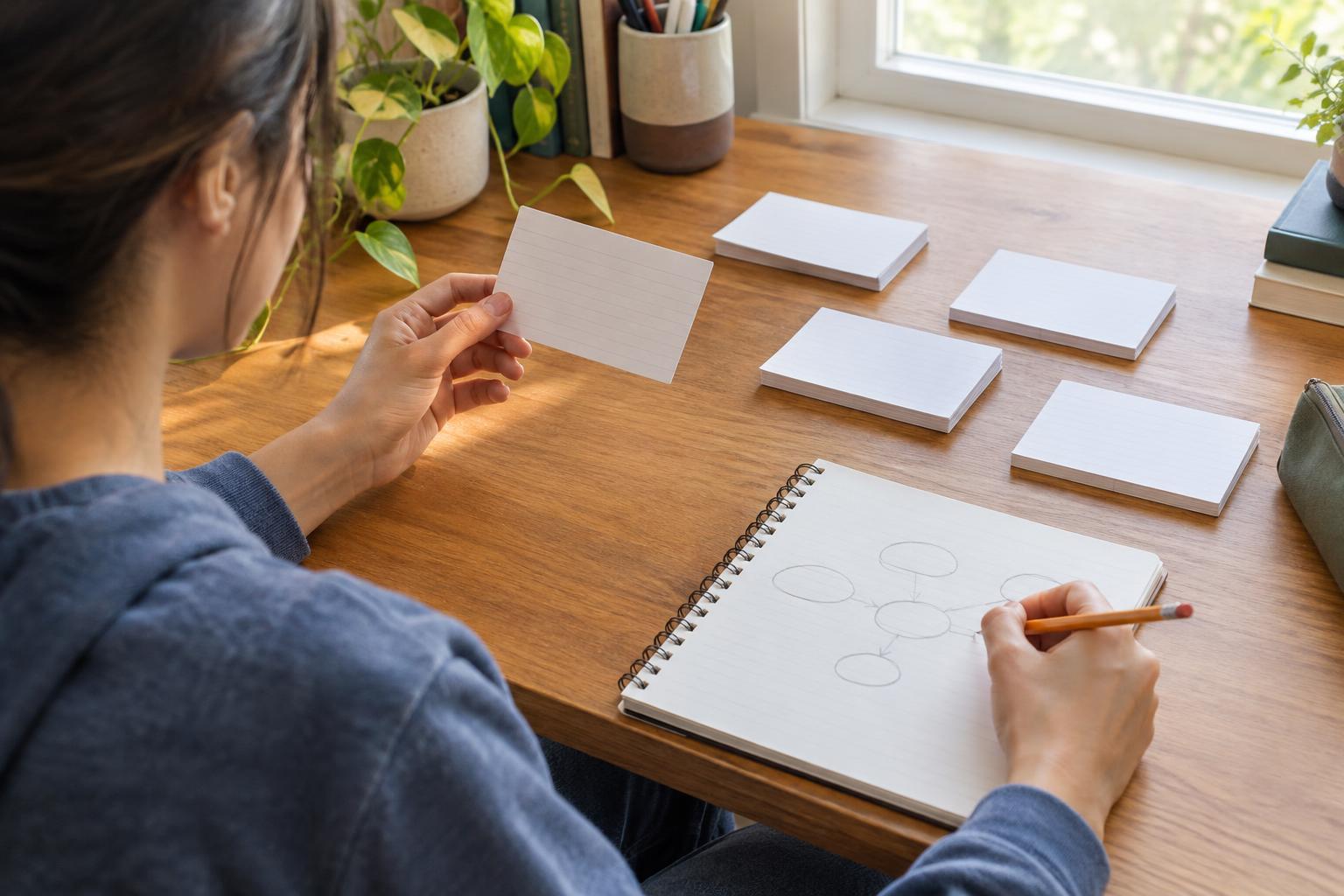
Looking at a page while you read it can make an idea feel clear. To find out what you know without that support, close your notes and try to explain one heading in your own words. You can say it aloud, write two or three sentences, or draw a quick diagram. Then reopen your notes and compare. What did you remember accurately? What did you leave out or mix up?
For a process, try to describe the steps in order and say why each one matters. For a story or historical topic, explain how the main events or ideas connect. For a math example, cover the solution and work through the problem yourself. If you can follow the finished example but cannot choose the first step on your own, that is a useful gap to notice. It tells you to practice starting problems, not just reading solutions.
Give each gap a clear label
A note that says “I don't get it” can be hard to act on. Try naming the difficulty more precisely. Is a word unfamiliar? Is a fact missing? Do you understand the definition but not the example? Can you explain each step separately but not why they go in that order? A small question mark beside the exact line, paired with a short label, makes the problem easier to return to.
You might write, “Need an example of this term,” “Why do we divide here?” or “How does this connect to yesterday's lesson?” Keep your questions in one place if you can, such as the margin of your notes or a separate question list. Some gaps may turn out to be simple copying errors. Others may need more practice or an explanation from someone else. You do not have to solve them all during the first review.
Use the right next step for each question
Match your next move to the kind of gap you found. If your notes are incomplete, check a class resource or ask a classmate what you missed, then make sure the added information makes sense to you. If a term is unclear, find its definition in your course materials and write a sentence using it. If you understand an example but cannot do a similar task alone, attempt another problem before looking at the answer.
When you ask a teacher or classmate for help, bring the specific question and show what you have tried. For example: “I can do the first two steps, but I don't know why the third follows.” That gives the other person a clearer starting point than “I don't understand any of it.” If several questions depend on the same earlier idea, begin with that idea. Clearing one foundation can make the later notes easier to read.
Finish with a small check you can repeat
After filling a gap, test it again without looking. Explain the idea in a fresh sentence, answer a practice question, or make your own example. Being able to recognize an answer is different from being able to produce one. If you still need your notes to get started, leave the question marked and try again after more practice or help.
End your review by writing a short plan: one thing you understand, one question to ask, and one task to practice. This keeps review from turning into endless rereading. Your notes do not have to be perfect to be useful. They work best when they help you notice what you know, identify what you do not know yet, and take a specific next step.