Start with an idea and a manageable length
A good starting point is to decide what you want the routine to feel like. It could be playful, calm, energetic or dramatic. You can take inspiration from the mood of a song, a story you want to tell or a movement you enjoy doing. You do not need to represent an emotion perfectly; the idea is simply a guide when you are choosing steps.
Keep your first routine short enough that you can remember and repeat it. One section of music is plenty. Listen a few times and notice where the sound changes: perhaps a new instrument enters, the beat drops out or a phrase repeats. Those moments can help you decide where your dance should change, pause or return to an earlier move. If you plan to share a video publicly, check that you have permission to use the music.
Find movements that suit your space and body
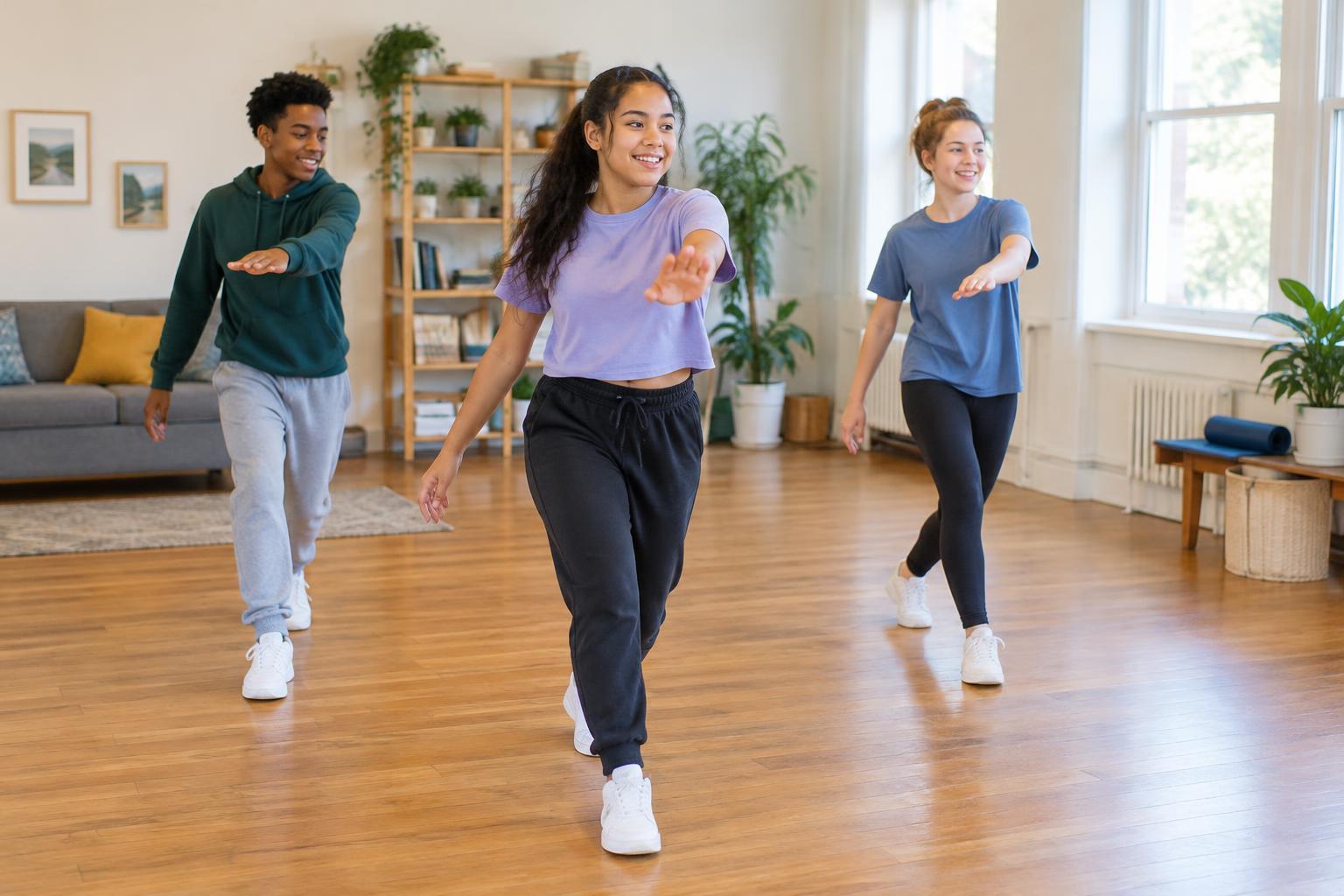
Before you choreograph, clear enough space to move without hitting furniture or other people. Wear shoes that suit the surface, or choose movements that work safely where you are. Start with a few gentle movements to get comfortable rather than jumping straight into your biggest steps. If something hurts, stop or change it.
Make a small movement list: perhaps a step to each side, a turn, a shoulder movement, an arm shape and a still pose. Try each move at different speeds or levels. A simple step can look new when you face another direction or add a pause. Choose movements you can do comfortably and consistently. Your routine is not less creative if you use seated movements, a smaller range of motion or no jumps.
Build a beginning, middle and end
Think of the routine as a short story with three parts. The beginning introduces your style, the middle develops it and the end gives the viewer a clear finishing point. You might begin with a still pose, repeat a favorite step with a variation in the middle and finish by returning to the opening pose. This makes the dance feel intentional without requiring a large number of moves.
To assemble the parts, group a few movements into a phrase you can repeat. If the music has a steady beat, counting can help: try fitting one movement phrase into eight counts, then create a second phrase for the next eight. You can also follow sounds or lyrics instead of counting. Give yourself a way to remember the sequence, such as writing “side steps, turn, pause” on paper or making a private practice recording.
Connect the parts without rushing
Transitions are the movements that take you from one idea to another. They can be as simple as walking to a new spot, turning to face a different direction or letting one arm motion lead into the next step. Practice the moment between phrases, not just the phrases themselves. If you keep getting stuck, simplify the last move of one phrase or the first move of the next.
Leave room for contrast. If every moment is fast and large, the routine may feel crowded. A pause, a slower gesture or a repeated move can make the energetic moments stand out. Try dancing once while focusing only on timing and once while focusing on expression. Notice what feels natural, then adjust the choreography rather than forcing yourself to keep a move that does not fit.
Practice, revise and make it yours
Run the routine from start to finish at a comfortable pace. When you forget a step, mark that spot and practice the few movements around it. Short, focused run-throughs can be more useful than repeatedly starting over. If you want feedback, show it to someone you trust and ask a specific question, such as whether the ending is easy to recognize or whether a transition looks clear.
A routine is finished when it communicates your idea and you feel ready to perform it, not when every move looks exactly like someone else’s. You might perform it for friends, keep it as a personal project or revise it later. The useful skills are the same either way: making choices, testing them, solving problems and giving your own ideas a form others can see.